Southern Lebanon around Tyre, a coastal city south of the Litani River, has been a contested security zone for decades. Hezbollah built a substantial military presence there, and Israel has repeatedly conducted operations against it. After the latest conflict, Israel still holds territory in the south and has tied withdrawal to eliminating Hezbollah’s military presence. Lebanon, meanwhile, cannot establish exclusive control over the area.
What political arrangement might follow if Hezbollah were eliminated and Israel nevertheless refused to return the territory to the previous order?
To answer that question, it helps first to outline the region. The territory at issue lies between the Israel-Lebanon border and the Litani River, the zone UN Security Council Resolution 1701 describes as lying between the Blue Line and the Litani, covering about 850 square kilometres of established towns and villages with direct access to the Mediterranean. Middle East Monitor, reporting demographic data from Anadolu Agency in September 2024, estimated approximately 200,000 residents in this area south of the Litani.
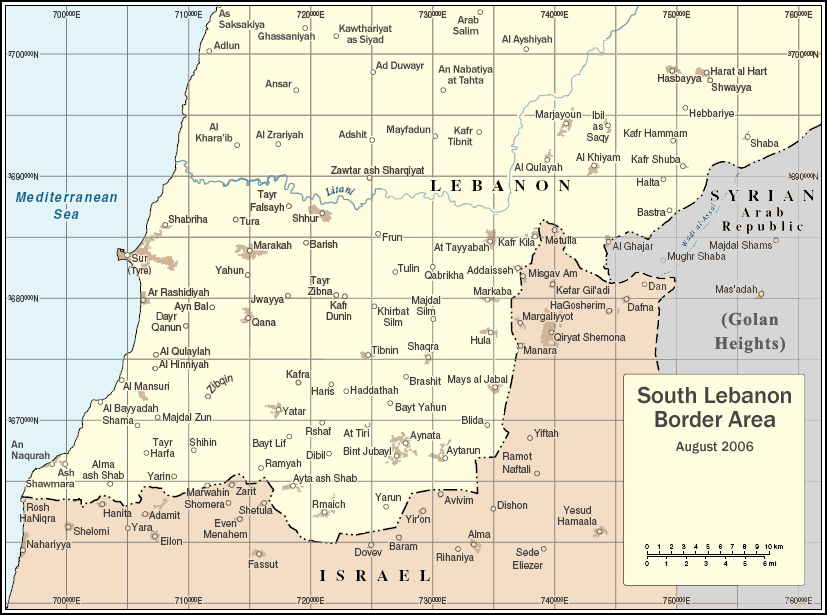
Southern Lebanon between the Israel-Lebanon border and the Litani River, the area under consideration for the proposed Tyre Republic. Map from Wikimedia Commons.
On this territory, Israel would want to prevent a hostile armed organization from re-establishing itself south of the border, and Lebanon would want to restore sovereignty and avoid a permanent Israeli military presence. Restoring Lebanese control would have to be considered first, but the previous arrangement is exactly what allowed Hezbollah to grow into a military power independent of the Lebanese state. One alternative would be a protectorate: the Tyre Republic, a capitalist state with laissez-faire economics, with Lebanon, Israel, and the United States as suzerain powers and a contingency plan for full sovereignty. That path requires public support for Hezbollah to cease. Otherwise neither a new political order nor even transitional administration by a private charter company is possible.
During the transition, Lebanon and Israel would retain sovereignty but delegate day-to-day administration to a private charter company. Lebanon, Israel, and the United States would secure the protectorate and prevent Hezbollah or any other independent armed group from re-establishing itself, without themselves managing day-to-day affairs. Once the charter company has built the necessary institutions, it would dissolve, and the Tyre Republic would assume governance under the protectorate: a capitalist state with laissez-faire economics and a government limited to the police, the courts, and the military.
The republic would justify capitalism on Ayn Rand’s Objectivist philosophy. Objectivism grounds capitalism in moral, not merely economic, arguments. Where questions remain unsettled, the republic would rely on Objectivist philosophical interpretation.
Under laissez-faire capitalism, the Tyre Republic would have law but no regulation. Law is reactive: if person A violates person B’s rights, person B sues in court afterward. Regulation is preventive: it forbids or compels conduct in advance, before any rights have been violated. Only law protects rights. Regulation places barriers to innovation, opens the door to government lobbying and favoritism, and the presence of regulation always leads to statism, the opposite of laissez-faire. People would be free to act as they choose until they violate someone else’s rights. Economic activity would rest on objective law: contracts, property rights, and prohibitions on force and fraud, not on permits required before acting.
The Tyre Republic would invite people from across the Middle East who prefer a more Western, free society, unconstrained by anachronistic traditions. It would be a beacon of hope for resolving tensions across the wider Levant, much as Israel has been. However, unlike Israel, it would practice pure capitalism and would not follow an international policy of appeasement, which Israel has pursued for many years (see references). As Ayn Rand stressed, capitalism cannot survive on altruist premises; it requires an egoistic foundation. Objectivism has also formulated a policy on foreign relations that rejects appeasement.
The republic’s spirit can be compared to the American idea of a political nation: a Little America in the Middle East. Citizenship would rest on allegiance to the constitutional order, not on ancestry, ethnicity, or faith. That would distinguish Tyre from Lebanon’s confessional system and from Israel as a Jewish state, although it would support Zionism, the idea that Jews need a country of their own and that country is Israel. Neither the government, private citizens, nor a majority vote could use force to impose religious observance.
The name of the new state matters too. Although Shakespeare’s Juliet argued that a rose by any other name would smell as sweet, in politics a name can connote a certain ideological program. For the republic to be accepted, the name must belong to the region’s identity yet not import baggage that would bias ideas in the wrong direction. The name refers to the present-day Lebanese city of Tyre on the coast and to its past. In Phoenician, Greek, and Roman times, and later, ancient Tyre was an industrial center of production and trade. The Tyre Republic would be built in the same spirit: a productive, industrial society.
Any new order would face local realities: parts of the population have long supported Hezbollah, and some may retain sympathies for Hezbollah or Islamism. The republic would protect freedom of thought and peaceful expression, but the law would not protect calls for violence or attempts to take others’ rights by force. Teaching or inciting violence against Jews, Christians, Muslims, or anyone else would not be permitted, nor would organizing, financing, or arming private militias.
In peacetime, movement across the Lebanon and Israel frontiers would be unrestricted. Anyone could arrive without a visa, take a job, and settle. Residents would have the same legal rights as citizens, except for political rights, above all the right to vote. Residence, employment, property ownership, business, and access to courts would require no permit. Citizenship would confer voting rights subject to constitutional requirements. If someone broke the law, he would be pursued after entry through ordinary police work, not through border checks. Courts and police would apply the same statutes to everyone on the republic’s territory. With no welfare state to fund, resources could go to an effective police force instead, without which open borders would become a vulnerability.
Such a scenario describes a difficult but possible path for a populated and strategically important region. Whether it could work depends on whether the local population accepts the new constitutional order and whether all parties agree to the transition terms described here.

Published by Anthem Liberty Foundation
References
- Tyre (UNESCO World Heritage Centre)
- South Lebanon map (Wikimedia Commons)
- Middle East Monitor, Litani River at the heart of conflict between Israel, Hezbollah (September 2024, demographic estimate via Anadolu Agency)
- Reuters, After US criticism, Israel ties Lebanon withdrawal to Hezbollah disarmament (August 2026)
- Ayn Rand, “The Wreckage of the Consensus” in Capitalism: The Unknown Ideal (1967), on foreign policy and the rejection of appeasement
- Ayn Rand, “The Roots of War” in Capitalism: The Unknown Ideal (1966), on statism as the cause of war and capitalism as the system opposed to war
- Elan Journo, What Justice Demands: America and the Israeli-Palestinian Conflict (2018)
- John David Lewis, Nothing Less than Victory: Decisive Wars and the Lessons of History (2010), on decisive war and the failure of defensive restraint and appeasement
- Elan Journo, After Israel’s ‘Pearl Harbor,’ Nothing Less than Victory (New Ideal, October 2023), on Israel’s restraint and appeasement of Hamas
- Elan Journo, Stop Ignoring Justice in the Israel–Hamas War (New Ideal, October 2023), on Israel stopping short of defeating Hamas
- Ben Bayer, We Ignore the Unconditional Right to Self-Defense at Our Peril (New Ideal, 2024), on Israel’s years of restraint toward Hamas
- Onkar Ghate, Elan Journo, and Boaz Arad, The Hamas War on Israel (New Ideal Live, October 2023), on Israel’s appeasement as “the sanction of the victim”
- Elan Journo, It’s Past Time to Bury the Israeli-Palestinian Peace Process (New Ideal), on the moral failures of the peace process
- Elan Journo, Washington’s Pro-Hamas Foreign Policy (2006), on American appeasement and Israeli concessions
- Elan Journo, The Perversity of U.S. Backing for the Gaza Retreat, on U.S. pressure for Israeli concessions in Gaza
- Elan Journo and Ziemowit Gowin, How Biden Subverts Israel’s War on Hamas (New Ideal Live), on U.S. altruistic policy undermining Israel’s war of self-defense
- ARI’s Resources on Israel, Palestine, and the Middle East (New Ideal), curated list of related articles
